Saturday, July 28, 2012

Building a retaining wall/garden bed

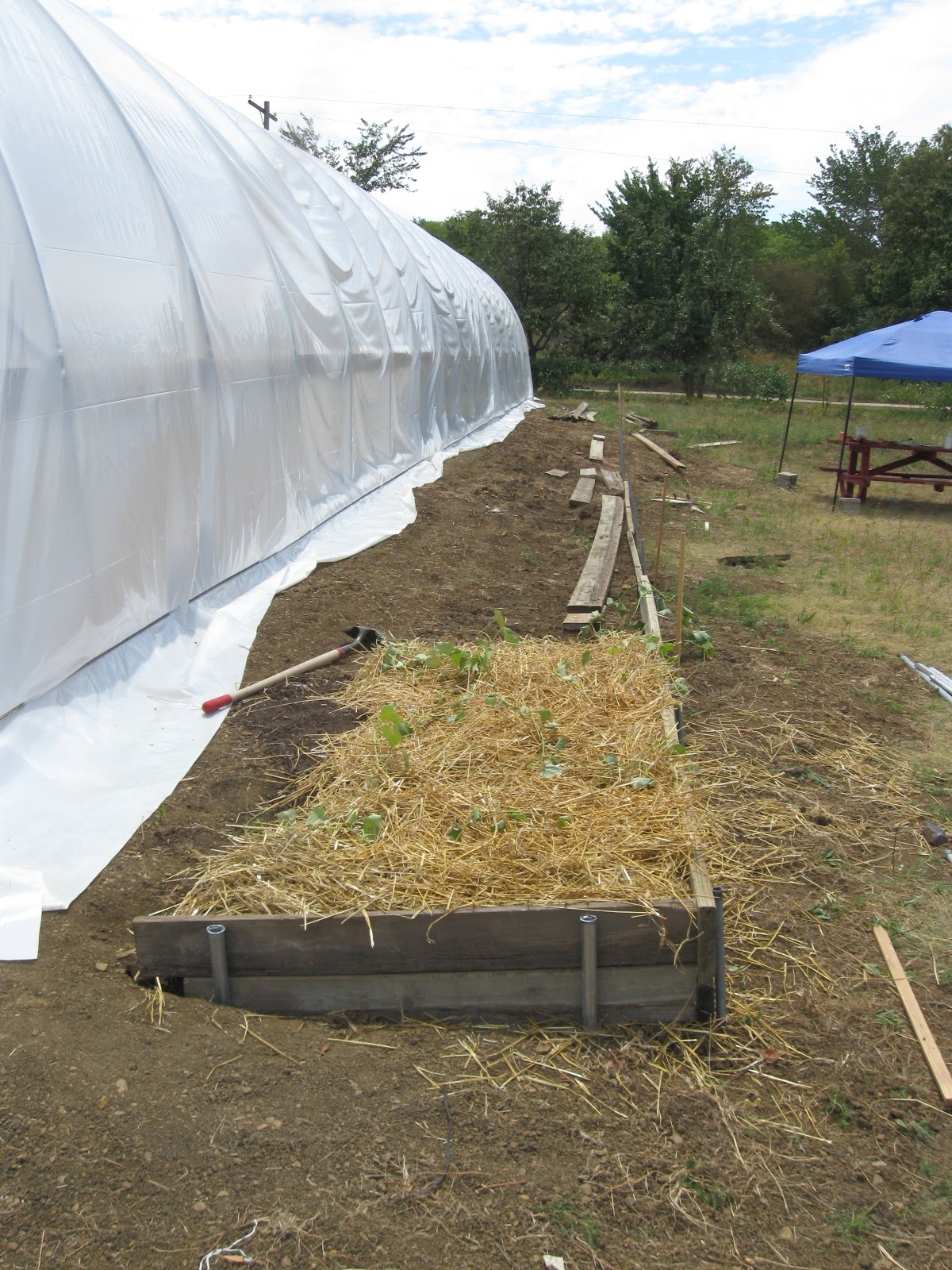
We began construction today on the retaining wall/planting bed on the West (downhill) side of the greenhouse.  It will eventually be a 92 foot long planting bed (equivalent to 4.5 of our beds in the old garden) with a stone staircase in the middle and an access path next to the greenhouse.

We began by driving wooden stakes 7' from the edge of the greenhouse (3' of aisle plus 4' of planting bed) so that we could visualize where the wall would go.  Next, we started laying out the boards.  We are re-using boards we salvaged when we disassembled the greenhouses.  Eventually, (and hopefully) the wooden wall will be replaced by a stone wall.  For now, we're using what we have!

Driving in the metal pipe pieces - bottom boards are set and leveled.

Each board had to be leveled.  We started at the North end of the greenhouse and leveled the front wall to be even with the ground at the edge of the greenhouse.  As we worked toward the middle of the hoop house, we had to dig down and add boards to follow the slope of the hill.  Each board was leveled.  In the middle of the wall, we are setting aside 4' to put in a staircase using stone we have yet to bring up from Peggy's house (check out previous post on foundations falling from the sky).  For today, we worked on the north wall up to the staircase.

Once we had all the boards measured, cut and leveled, we cut several pieces of pipe to use as braces.  They ranged from 30" to 6 feet depending on the slope.  Each pole was driven in at least half its length in order to hold back the weight of the soil that will be behind this wall.  Then we started setting the bottom boards and pushing dirt in behind to hold them in place.

Once the bottom boards were in, we started laying up the rest of the cut boards.  To hold them, we have to back fill as we go.  We didn't quite get all that done, so there is still a lot of dirt to move from the pile into this bed. 
Aaron is working on the corner.  Boards have all been cut and are laid next to where they will be.

We did get the corner filled in and we decided to plant some of our volunteer sweet potato slips.   Yeah more food growing on the farm!  Eventually, this bed will house our asparagus and perhaps some more perennial plants.  We would prefer to have things growing here that will always have roots to help hold the soil.


Sweet potatoes!

A view of where we are - lots of backfilling yet to do and the south side hasn't been started.

Friday, July 27, 2012

In-ground refrigerator

Now that our farm has long term residents, we had to find a way to keep food cold for more than a day at a time.  We've heard of people digging holes and burying barrels to use as a root cellar in the winter, so we decided to adapt this idea to create an in-ground refrigerator.

First, Jeremy and Aaron dug a hole big enough to hold 3 large coolers (about 2'x5'x2'deep).  Then, they lined the hole with some 1" extruded foam insulation we had left over from building the greenhouse at our house.  The coolers were placed in the hole and more scrap insulation was placed on top.  Then a scrap piece of siding was added and topped with 3 straw bales.  A makeshift roof appeared using the scrap roofing from our home greenhouse.
Coolers in the hole with the top layers removed.

Top insulation

Bales with scrap roofing on top.  A board gets placed over these to keep them in place.

We've been very happy with its performance so far.  The ice that was put in around lunch on Tuesday was still partially frozen on Thursday afternoon!  We think that with a few improvements, it should be able to keep cold for 3 days at a time before the ice has to be refreshed.  When the highs get out of the 100's, it might even last longer than that! 

Woo hoo for low tech refrigeration!

Thoughts about work

Opportunity is missed by most people because it is dressed in overalls and looks like work.
-Thomas Edison

Over the last several years, we have undergone a significant shift in our attitude toward physical work.  We once considered work something to be avoided – it was uncomfortable, it made our muscles sore, it was hot, inconvenient and any number of other associations.  Shifting from that perspective to considering work like an old friend – something that validates us, gives us purpose and produces innumerable benefits – has taken a lot of thought, determination and adjustment.  I thought I would write a bit about how we got to this perspective in case it helps anyone else.

The first obstacle we faced was deciding that the effort was worth it.  For example, when we decided to build our first 4 garden beds the decision took a while and was made a bit reluctantly – the garden beds weren’t going to build themselves and we wanted fresh vegetables!  It probably helped that we couldn't afford to hire anyone to do it for us.  So, we went out on several fall days and created our first 4 garden beds.  We complained, we drug our feet and we made a great show of being glad to be back inside when we were done.  It took us FOREVER compared to what we would do today.  At the same time though, there was a sense of pride that we had done it and the vegetables were really good!  That made the decision to expand the garden the next year easier – we had already done this once after all.  The work didn’t seem as daunting and we knew the reward would be more fresh food.  Over time deciding that something is worth the work has continued to get easier.

The next challenge was integrating work into our self-image.  We both saw ourselves as academics.  We did well in school, we liked school, we liked to read and discuss and debate.  How does that jive with wanting to go get sweaty with hand tools?  How can these 2 things go together?  It felt a little like telling the class nerd that the school was depending on them to win the basketball tournament. It just didn’t fit.

Then we discovered that there is no end of things to learn!  Learning to use a tool or build a raised bed is a different kind of learning than reading a book or taking a test, but creates the same sense of satisfaction.  We found that we could use our love of books to learn about anything we wanted to try and then we actually got to do it!  There is such a sense of satisfaction in taking something from abstract words on a page to something you can see, touch and feel.  We became hooked on finding new ways to learn and apply that knowledge.

We also had a perception that somehow people who did physical work were special and separate – they must have some kind of training that let them do that kind of work.  Our grandparents had grown their own food, but they grew up doing it.  Clearly someone taught them what to do and that’s how they became good at it, right?  We didn’t have any training or any special skills.  We didn’t even know anyone around us who did any of these things.  How would we know where to start?

We still occasionally run into this one when we contemplate trying something new.  However, after trying quite a list of new things over the last several years we can confidently say that none of it was nearly as hard as we thought it would be.  There isn’t anything we’ve done that any adult willing to try couldn’t do.  That only makes sense when you think about it.  For millennia, people survived on what they grew themselves.  That means that growing food has to be something that everyone can do, right?

An interesting side effect of work being this accessible is the sense of self confidence it breeds.  The skills don’t take long to master and from then on you have a skill you can use, teach and rely on.  When I think about how this might change people’s view of themselves and others around them, I have to wonder if having the opportunity to be good at something would make people more confident in themselves.  I think of this particularly for our children.  My kids will always know that there are tons of things they’re good at, even if none of them relate to current social norms.  It is my hope that this confidence will form the foundation they will need to go through life.  They have value – concrete, real and tangible value and ability.  That’s a powerful thing that more people should have (in my humble opinion).

So what’s the moral of this story?  Do more work!  Just kidding…mostly.  Changing our perspective from "hating" work to enjoying it has opened up a whole new worrld for us.  We are happier, healthier and more secure in our lives.  Being willing to do work has allowed us to meet so many amazing people and try so many cool things that we now can't imagine a life where we aren't working.  Work is our friend - we like it!

Thursday, July 26, 2012

The cavalry has arrived!

Just when we were looking at the to-do list and coming to the sobering realization that we were either going to stop sleeping or delay some things until next year, an amazing thing happened.  A wonderful woman we met at the clay plaster workshop called to say that she had two friends participating in the Worldwide Opportunities in Organic Farming (or WOOF) program in the area and she was wondering if we needed help on our farm.  Seriously?  YES!  Of course we could use help on our farm!

So last weekend we met up with Aaron and Sara to look at the farm and talk about what we could offer in exchange for their time.  The WOOF program's normal arrangement is that the WOOF'er works for 4 hours a day in exchange for room and board at the farm and an education in the things the farm is doing.  For our part, we take the responsibility to feed and house them and to help them learn about everything we're doing. 

So now Aaron and Sara are camping at the farm with arrangements to be able to come to our house for laundry, hot meals and showering.  We're providing food either that they can prepare on the farm or that we have prepared ahead of time.  Aaron has already finished painting the north end of the greenhouse and finished priming the south end.  He did a fabulous job - much neater that I am with a paintbrush!  He's also taken over the daily goat care and regular garden watering which is a huge relief.
Aaron and Sara

Check out the awesome paint job!

Over the course of the 3 weeks they plan to stay, they'll have the chance to learn about how to do swales both on contour to retain water and off contour to move water, how to plant trees, how to create lasagna garden beds, how to plant a vineyard and probably a few other things.  For our part, we'll be able to get several garden beds built, create the vineyard for our grapes and get our new fruit trees planted.  Those were going to be a struggle for us amid all the other things we have to do so its fantastic news!

We can't express our gratitude and appreciation enough.  Sometimes the cavalry really does come riding in!

Wednesday, July 25, 2012

What to do when a foundation falls from the sky…

Most of you are probably unaware, but we have been deeply embroiled in a debate about the foundation for our future house.  Both of us would like to have a stone foundation for a variety of reasons.  A stone foundation means we need A LOT of stone – many, many tons worth.  Buying that much stone would be completely out of the question for our budget which leaves us with the unappealing prospect of quarrying it out of our woodlot.  Digging and moving that much stone would take all winter when we need to be working timbers and means that we would need to clear a road into the woods to be able to get the stone out.  We would also have to dig up a large chunk of the ridge which would mean clearing several trees and figuring out how to get rock up the ledge to the top tier of the ridge.  Ugh.  Thus our debate – do we quarry on our property or do a traditional concrete foundation?  We’ve been going back and forth on this issue for several weeks.

Then, this past Sunday we saw the following ad in the Lawrence Journal World:  “Scythe - includes spare blade. Also barn stuff. All for $50.”

We’re always looking for good tools and even a cheaper, heavier scythe would be put to good use on the farm, so we called.  It took until Tuesday to make it out to look at the scythe. 

When Jeremy arrived, he met the current owner - a wonderful older lady named Peggy.  She took him into the barn to see the scythe and proceeded to tell him that the “barn stuff” listed in the ad included all of the following:  a small stock tank, a garden cart, a digging/pry bar, a cider press and a hand cultivator.  The scythe also turned out to be 2 scythes, 2 blades and a hand held brush cutter.  Wow!  Jeremy expressed his gratitude, put the scythes into the car and explained that he would have to come back with our truck or the hatchback to get the rest.

Fast forward a few hours.  I get home from work and Jeremy shows me the scythes.  They’re all a bit rusted, but in very salvageable condition.  All 3 blades are stamped blades, not forged blades which means we will either have to peen out the edge a fair bit or continue to sharpen them with a file (and much more often).  Jeremy rattled off the list of other things we needed to go pick up and my eyes kept getting bigger, and bigger and bigger.  The scythes by themselves were easily worth the $50.  I’m sure it was evident on my face that I couldn’t believe our luck.  After dinner, we got in the matrix and drove back down to pick up the rest of the “barn stuff”.

Everything miraculously fit into the back of the matrix with the seats folded down (we were surprised to – this is why we bought a hatchback).  After loading, we went to the house to tell Peggy thank you and so that I could meet her.  When we got there, she was rolling a small compost tumbler out of the garage which she said we were welcome to have as part of the “barn stuff” also.  We inquired about a set of scaffolding that was in the barn and she replied that she had bought it for $15 and would be happy to sell it to us for $15.  Sold! 


As we were saying goodbye and getting ready to drive home, we complimented her on the stone facing on her house.  She explained that the stones came from the foundation excavation.  Then she said that they had dug up a lot more stone when they recently re-did their water line and the stone was piled up at the end of a road into the woods (she pointed the road out).  If we could use some stone, we were welcome to it. 

At this point, I’m about to fall over in shock.  Did she really just say that she had free stone?  That all we needed to do was go pick it up?  I looked at Jeremy and could tell that he was thinking the same thing.  We calmly say that we’ll walk over and take a look.  What we found was 2 piles of newly dug rock.  The first was about 6 feet tall and 8 or 10 feet around.  The second was about 4 feet tall and 6 or 8 feet around.  There was also a 50 yard long, 2-3 foot tall windrow of older stone that had clearly been dumped there many years ago.  In total, we were looking at enough stone to do the bath house foundation, the house foundation and likely the root cellar and barn foundations.  It was all right there at the end of an easily drivable road, piled and waiting to be picked up.  We couldn’t believe it.

We walked back up to the house to talk to Peggy.  We asked if she was talking about just the new stone or all the stone.  She laughed, looked around the yard at all the stones growing out of the ground and said, “take all you want – we have no shortage here!”  Apparently the older stone came out of the foundation to the house when it was built in 1980.  We asked if we could please pay her something for it and she flatly refused.

From here the only possible sticking point would be if we needed to move stone right now.  We had planned to quarry stone in the winter after we finished the bath house.  Taking a few weeks (at least) to move stone now would mean delaying that project to the point that we could easily run out of non-freezing weather.  So we asked how long we had to pick up the rock.  She said they weren’t going to sell the house until next March and we were welcome to pick it up anytime between now and then. 

So, in short, we went looking for a scythe and found a foundation.  Unbelievable.  Absolutely unbelievable. 

In other news, we will be spending our winter ferrying many tons of rock from Peggy’s house to the farm where it will get sorted and stacked in preparation for building the foundation.  If any of you have some free time and want some good productive exercise – let us know! 

Tuesday, July 24, 2012

The Straw is Home!

Sunday was the day.  We spent about 4 hours moving straw from the farmer's barn into our hoop house.  It was 105 when we started and 90 when we finished, so you can imagine how much fun it was to be heaving bales!  By the end, we were racing dark to get the last load into the hoop house.  In fact, we loaded it using the red glow of the trailer's tail light and unloaded it in the reflected glow of the truck's headlights.  Enjoy the pictures!
First load in

second load in

third load in - getting dark
All in!

Jacob was our man on top rolling the bales down to Jeremy and I

Third load in the hoop house as we start to unload

I don't have a picture of the last load after it was unloaded because it was long since dark.  I will try to take one next time we're at the farm.

Monday, July 23, 2012

Beginning the orchard

On Friday, we took advantage of Pine's clearance sale to purchase 12 fruit trees.  For those who are local to Lawrence, I would encourage you to check out Pine's as soon as you can!  They have an amazing variety of really nice flowers, herbs, perennials and fruit trees - all in really nice shape considering the heat.  They are a family operation and they take great pride in their plants.

The trees were loaded gently into the back of the truck and then slowly driven to the farm, much to the chagrin of everyone behind us on Hwy 24.  Sorry guys!  Once at the farm, we unloaded the trees onto a tarp close to the greenhouse where they will stay until we get their new homes ready. 

In all we purchased:

2 pears (early gold, Bartlett)
3 plums (blackice, blues jam, waneta)
2 apricots (moongold, sungold)
4 peaches (redhaven, baily hardy peach, reliance, elberta)
1 apple (McIntosh)

With the exception of the apple, we got one of every variety they had.  With the apples, we were more particular.  First, we think both our apples survived the transplant so we already have a gala and an arkansas black apple.  Second, we desperately need resistance to cedar apple rust.  The McIntosh is the only one with CAR resistance in the bunch, so its the only one we bought.  Next year for spring planting we'll probably hunt through the catalogs for other varieties with CAR resistance to help round out our apple trees.

With a little luck, these trees will provide fruit for us in about 3 years.  After sampling peaches and nectarines from the farmer's market this weekend, we can't wait!